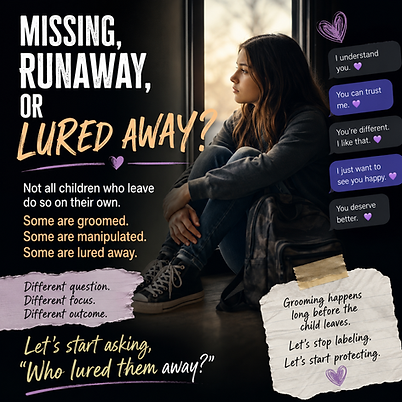
Missing, Runaway, or Lured Away?
By Sheri Lopez
When a child goes missing, one of the first questions people ask is, "Did they run away?"
I've heard that question countless times over the years, yet I believe we're asking the wrong question.
What if that child didn't simply run away?
What if they were groomed?
What if someone spent weeks—or even months—building trust, meeting emotional needs, and convincing that child that leaving was their own idea?
Those are two very different situations, yet we often place them under the same label.
When a child is reported missing, the word missing tells us only one thing—we don't know where they are. It describes a child's status, not their story. Yet too often, we rush to explain why they are missing before we know the facts.
The label runaway can also be misleading.
Certainly, some children leave home because they are fleeing abuse, neglect, conflict, or acting impulsively. But many children labeled as runaways are living in foster care, group homes, or other out-of-home placements. Many have experienced trauma, instability, or multiple placements, making them especially vulnerable to someone who offers attention, acceptance, or the promise of a better life.
What we often fail to consider is that someone may have spent weeks—or even months—preparing that child to leave. Through attention, trust, validation, gifts, and emotional support, a predator gradually convinces a child they are loved, understood, and better off somewhere else, and by the time the child physically leaves, they have often already been emotionally and psychologically led there.
We often talk about predators gaining access to children through computers, tablets, gaming platforms, and cell phones. But think about what that really means. The person communicating through that screen may ultimately become the reason a child walks away from home, foster care, or a group home on their own.
To everyone else, it appears the child made an independent decision.
In reality, that decision may have been carefully cultivated through grooming.
That isn't simply running away.
That is being lured away.
Sometimes trafficking begins with a child walking out the front door to meet someone who convinced them they were loved, understood, and better off leaving the people trying to protect them.
I know because it happened to me.
When I was fifteen years old, I was groomed months before I was ever trafficked. Looking back, I can clearly see that my trafficking did not begin the first time I was sold, it began with grooming, and that is the part society often misses.
Words matter because they shape how professionals respond and how children are viewed. Too often those children are labeled rebellious or troubled, while the person who manipulated them remains invisible.
Instead of asking, "Why did this child run away?" perhaps we should begin asking:
-
Who recently entered this child's life?
-
Has someone been communicating with them online?
-
Has someone been providing gifts, money, or emotional support?
-
Has the child become increasingly secretive?
-
Has someone encouraged them to distance themselves from family, caregivers, or friends?
Those questions shift the focus from blaming the child to identifying the person who may have groomed them, and this conversation is especially important for children in foster care and group homes. Too often, when they leave placement, they are immediately labeled runaways. While some leave voluntarily, others have been carefully targeted by individuals who recognize their vulnerabilities and exploit their need for connection and belonging.
Every runaway is missing, but not every missing child is truly a runaway, and it doesn't mean every missing child has been trafficked or every runaway was lured. But every missing child deserves an investigation that seriously considers the possibility of grooming and exploitation from the very beginning.
Perhaps it's time to rethink not only our investigations, but also our language. When a child disappears, investigators should immediately consider the possibility of grooming and quickly preserve electronic devices, social media accounts, messaging apps, and gaming platforms. Those digital footprints often reveal the person who spent weeks or months preparing that child to leave.
Maybe the question was never, "Did they run away?"
Maybe the better question is, "Who lured them away?"
Sometimes changing the question changes the investigation.
And sometimes, changing the investigation changes a child's future.
About the Author
Sheri Lopez is a human trafficking survivor, author, educator, and national advocate for grooming prevention. She is the Founder and Executive Director of Pearl at the Mailbox, Founder of the National Grooming Prevention Hotline, and Founder and President of the Arizona Human Trafficking Survivor Coalition. Sheri regularly educates professionals, communities, and policymakers on grooming, exploitation, prevention, and survivor-informed practices. She has testified before Congress, contributed to state and federal legislative efforts, and serves as a lived-experience expert witness in human trafficking cases. Through her work, she is committed to helping others recognize grooming before exploitation occurs and to preventing future victimization.
Learn more at www.pearlatthemailbox.org and www.azhtco.org